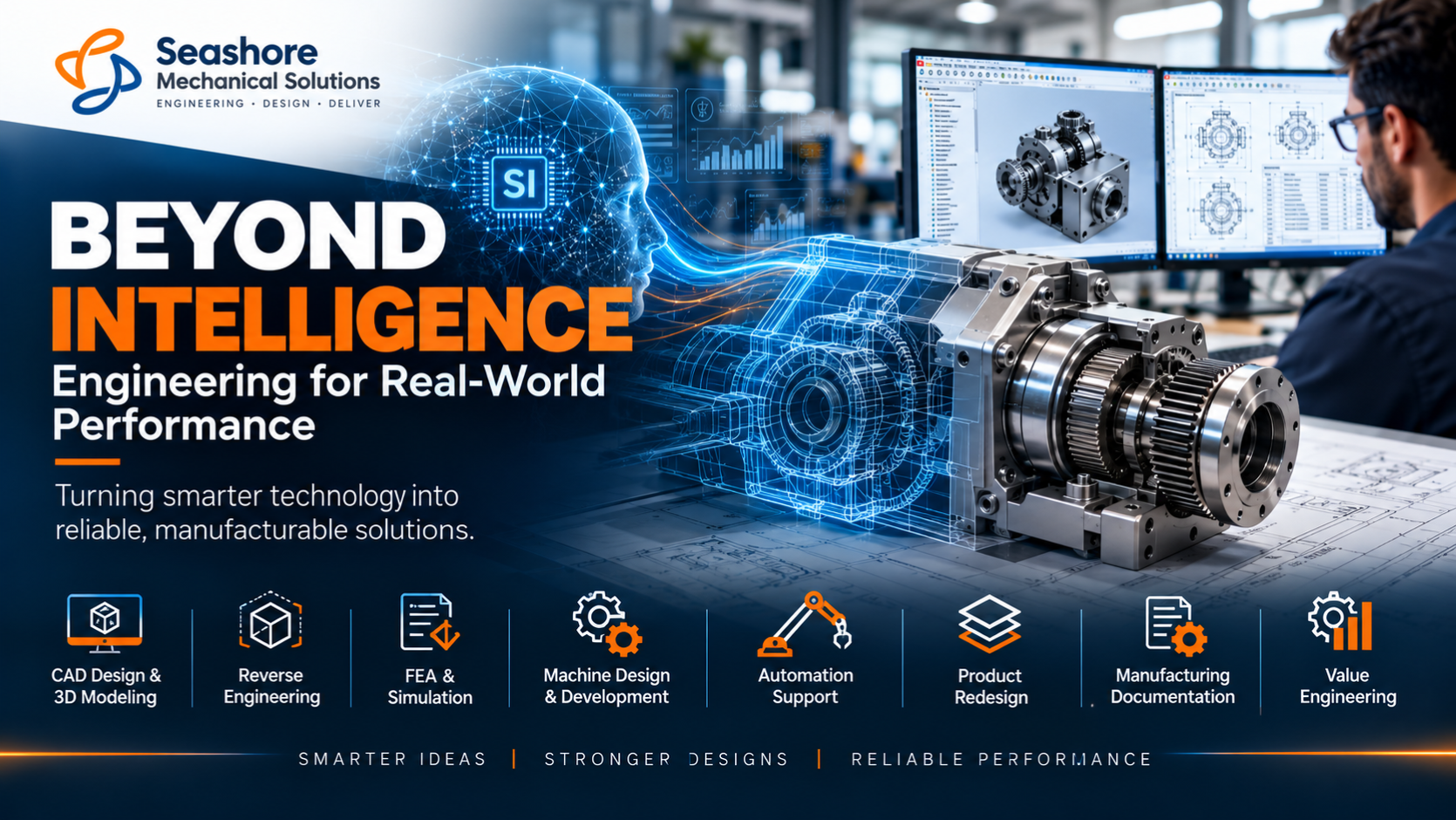
Artificial intelligence, automation, advanced simulation, and increasingly intelligent systems are changing the way manufacturers design products, operate equipment, and make engineering decisions.
But there is an important reality that sometimes gets lost in the conversation around AI and Super Intelligence (SI):
No matter how intelligent a system becomes, it still has to perform in the physical world.
A robotic arm still needs structural stiffness and positioning accuracy. A machine frame still needs to handle real loads. A mechanical component still has to withstand stress, vibration, heat, fatigue, and repeated operation. An automated production system still has to be manufacturable, maintainable, and reliable.
This is where mechanical engineering connects digital intelligence with real-world performance.
At Seashore Mechanical Solutions, we help manufacturers turn ideas, digital models, automation concepts, and existing equipment into practical, validated, production-ready engineering solutions.
Smarter Technology Still Needs Strong Engineering
AI can process information faster. Automation can improve consistency. Advanced controls can make complex systems more responsive.
But none of these capabilities can compensate for a poorly designed mechanical system.
A robotic cell may have advanced controls, but if the structure flexes too much, accuracy suffers.
A machine may use intelligent monitoring, but if vibration is not controlled, reliability drops.
A product may be digitally optimized, but if it is difficult or expensive to manufacture, the business value is limited.
The technology may determine what should happen.
Mechanical engineering determines whether it can happen reliably, repeatedly, and economically.
Turning Ideas Into Production-Ready Systems
The challenge for many manufacturers is not generating ideas.
It is turning those ideas into practical, manufacturable, and reliable systems.
That requires strong engineering across several areas:
- CAD design and 3D modeling
- Reverse engineering
- Product redesign
- FEA and simulation
- Machine design
- Automation support
- Manufacturing documentation
- Prototyping and validation
Together, these capabilities help move a product or machine from concept to production with fewer surprises.
Simulation Helps Reduce Risk Before Production
One of the most expensive times to discover a design problem is after a prototype has already been built.
At that stage, redesign can mean more engineering time, more tooling, more prototypes, and more delays.
Simulation helps move many of those decisions earlier.
Using FEA, structural analysis, thermal simulation, CFD, fatigue analysis, and motion studies, engineering teams can evaluate how a design may behave under real operating conditions.
Simulation can help answer questions such as:
- Will the component withstand the expected load?
- Could vibration affect reliability?
- Will thermal expansion create fit or performance issues?
- Can the design survive repeated operating cycles?
Simulation does not replace physical testing.
It helps make physical testing more focused and efficient.
Reverse Engineering Should Create Improvement Opportunities
Many manufacturers still depend on legacy parts and equipment.
Sometimes the drawings are missing. Sometimes the OEM no longer supports the part. Sometimes the design was created around older manufacturing methods.
Reverse engineering can recover the engineering data behind those components.
But recreating the exact old design is not always the best answer.
A better approach is to ask:
- Can the part be simplified?
- Can material usage be reduced?
- Can multiple components be combined?
- Can manufacturing cost be lowered?
- Can serviceability and reliability be improved?
In many cases, the best replacement part is not an identical copy.
It is a better-engineered version of the original.
Automation Is Changing Engineering Workflows Too
Intelligent technology is also changing how engineering teams work.
Engineers often spend significant time on repetitive activities such as:
- Updating similar CAD models
- Creating product variants
- Revising drawings
- Generating BOMs
- Preparing documentation
With CAD automation and design automation, many of these tasks can be standardized.
That means faster design cycles, fewer manual errors, and more consistent engineering output.
The goal is not to replace engineering judgment.
It is to reduce repetitive work so engineers can focus on higher-value decisions.
Intelligent Manufacturing Still Depends on Mechanical Engineering
Automation and robotics are a clear example of the connection between intelligence and engineering.
A robotic system may use sophisticated software, sensors, and controls.
But performance still depends on mechanical factors such as:
- Frame stiffness
- Alignment
- Motion accuracy
- Vibration
- Backlash
- Thermal growth
- End-effector design
- Component durability
Software may tell a mechanism where to move.
Mechanical engineering determines whether it can get there accurately and keep doing so over thousands or millions of cycles.
Beyond Intelligence
The future of manufacturing will likely include more AI-assisted engineering, robotics, digital twins, simulation-driven development, connected machines, and automated design workflows.
But underneath all of that, technology will still be physical systems that must perform reliably.
- Frames.
- Bearings.
- Gearboxes.
- Motors.
- Structures.
- Fixtures.
- Machines.
- Industrial components.
Each still needs to be designed, analyzed, manufactured, and maintained correctly.
That is why the future is not simply about smarter technology.
It is about combining intelligence with strong engineering.
At Seashore Mechanical Solutions, we help manufacturers turn engineering challenges into practical, production-ready solutions through CAD design, reverse engineering, simulation, machine development, product redesign, automation support, and manufacturing engineering.
Better engineering decisions. Better manufacturing outcomes. More reliable real-world performance.
Because intelligent technology creates the most value when the engineering behind it works where it matters most — in the real world.