Manufacturing Cost Reduction Through Product Redesign: A Practical Guide for Manufacturers
When manufacturing costs increase, most companies immediately focus on suppliers.
They negotiate pricing.
They source alternative vendors.
They look overseas.
They reduce margins.
But what if the largest savings opportunity is already sitting inside your product design?
After working with manufacturers for more than 15 years, we’ve found that some of the biggest cost reduction opportunities come from rethinking how products are designed and manufactured.
In many cases, products continue to be built using methods developed decades ago. Manufacturing processes evolve, materials improve, and production technologies advance, yet product designs often remain unchanged.
This creates hidden inefficiencies.
Why Manufacturing Costs Continue to Rise
Manufacturers across Texas are facing increasing pressure from:
- Rising labor costs
- Skilled welder shortages
- Increasing material costs
- Longer production lead times
- Supply chain disruptions
- Higher quality control requirements
Many companies assume these challenges are unavoidable.
They aren’t.
The first step is understanding where costs truly originate.
The Hidden Cost of Welded Assemblies
One of the most common opportunities we identify involves welded assemblies.
A product may consist of:
- Multiple fabricated components
- Numerous weld joints
- Secondary machining operations
- Additional inspection requirements
- Complex assembly processes
Every additional component adds:
- Manufacturing labor
- Welding labor
- Inspection labor
- Inventory complexity
- Installation complexity
- Potential failure points
Many of these costs become accepted simply because “that’s how we’ve always built it.”
A Real Example
A client in the fluid management industry was manufacturing a component using multiple welded pieces.
The part functioned well.
However, production required:
- Multiple fabrication steps
- Significant welding labor
- Additional quality inspections
- Longer production cycles
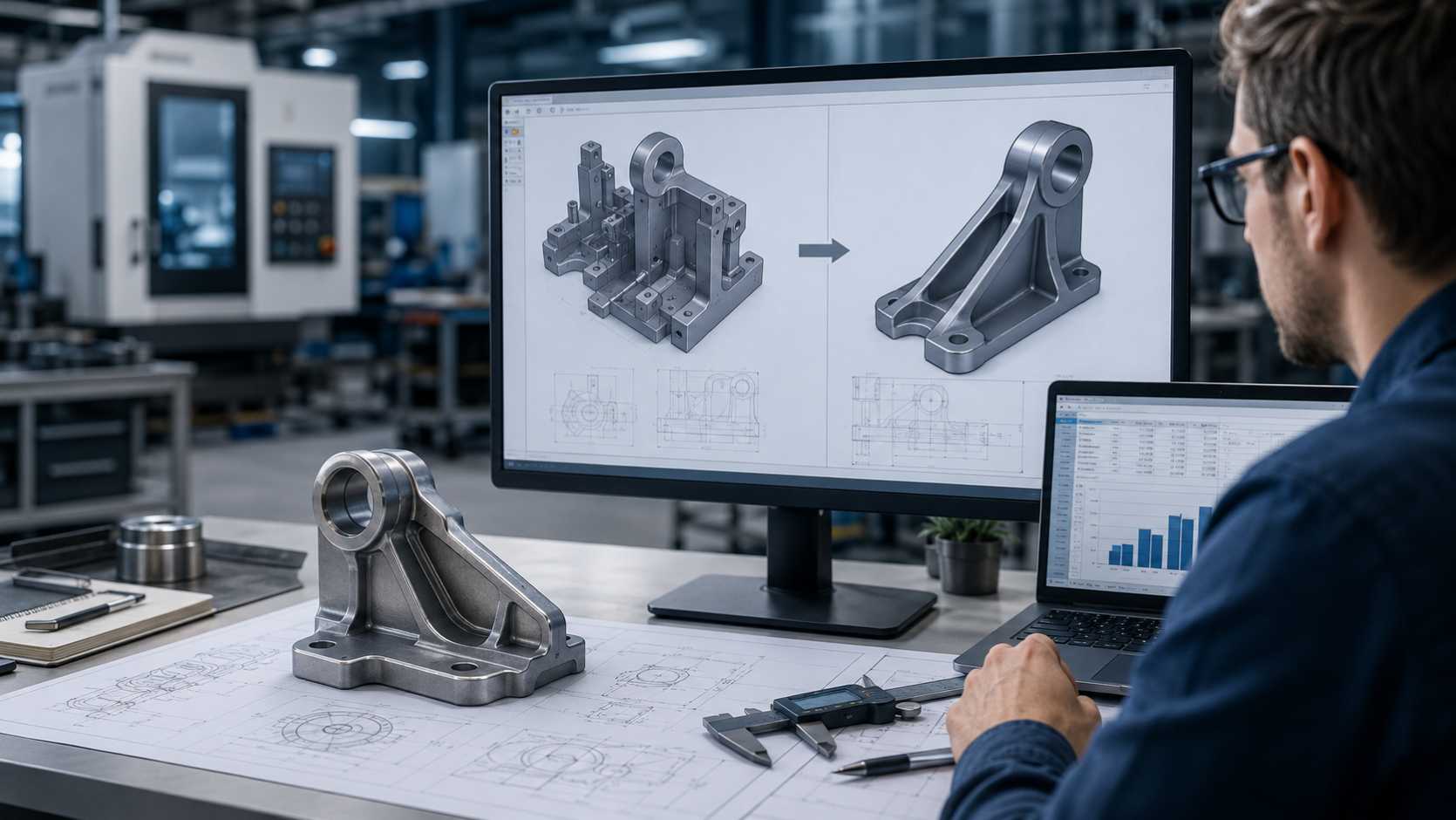
Rather than simply reproducing the existing design, our engineering team evaluated whether the assembly could be simplified.
Using reverse engineering, CAD redesign, Design for Manufacturing (DFM), and engineering validation techniques, the assembly was redesigned into a single integrated component.
The result:
- Approximately 30% reduction in part cost
- Reduced manufacturing time
- Improved quality consistency
- Reduced installation effort
- Fewer potential failure points
The greatest savings did not come from a supplier change.
They came from a design change.
The Five-Step Product Redesign Process
Step 1: Define Business Objectives
Before redesigning anything, identify the objective.
Examples:
- Reduce manufacturing cost
- Reduce welding
- Improve reliability
- Reduce lead time
- Improve installation efficiency
The most successful redesign projects begin with measurable goals.
Step 2: Analyze Existing Manufacturing Processes
Evaluate:
- Number of parts
- Number of welds
- Machining operations
- Assembly steps
- Inspection requirements
Often, the manufacturing process reveals opportunities hidden within the design.
Step 3: Challenge Existing Assumptions
Ask:
- Can multiple parts become one?
- Can welds be reduced?
- Can assembly be simplified?
- Can materials be optimized?
- Can manufacturing methods be improved?
Many designs contain legacy decisions that no longer make sense today.
Step 4: Validate Through Engineering Analysis
Design changes should be supported by:
- FEA Analysis
- Structural validation
- Material evaluation
- Prototype review
- Engineering testing
This reduces risk before production changes occur.
Step 5: Implement and Measure Results
Successful redesign projects should measure:
- Cost savings
- Manufacturing improvements
- Quality improvements
- Reliability improvements
- Customer impact
Questions Every Manufacturer Should Ask
Before approving your next product revision, ask:
- Why does this part have this many welds?
- Can part count be reduced?
- Are there manufacturing steps that add no value?
- Are we solving today’s problems or yesterday’s problems?
- Could engineering analysis help simplify the design?
Final Thoughts
The most successful manufacturers continuously improve products long after the first design is released.
Product redesign is not about changing products for the sake of change.
It is about reducing complexity, improving profitability, increasing quality, and creating products that are easier to manufacture and maintain.
The question is not whether your product works.
The question is whether it can work better at a lower cost.
Ready to Reduce Manufacturing Costs Through Smarter Product Design?
Seashore Solutions helps manufacturers evaluate existing products, simplify complex assemblies, reduce part count and welding requirements, and validate redesign opportunities before production. Explore our Product & Value Engineering Services, Migration & Reverse Engineering Services, and Advanced Simulation & Validation Services to identify practical improvements that support lower costs, better quality, and production-ready results.