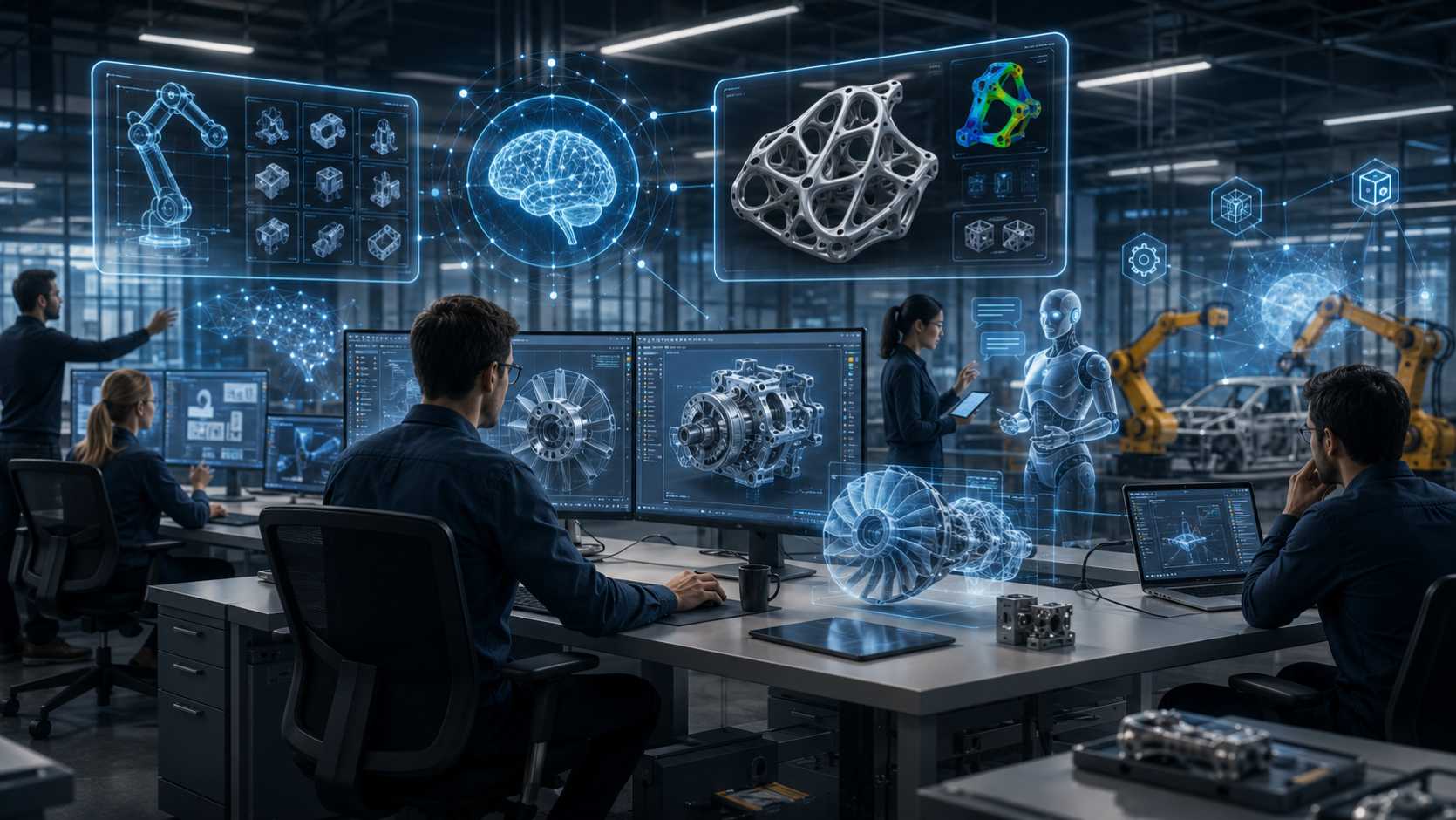
Artificial Intelligence (AI) is no longer the future of engineering – it is the present, and is currently transforming mechanical design and Computer-Aided Design (CAD). AI is streamlining repetitive modeling, generating new design ideas, and reshaping product development cycles to enable faster innovation, cost savings and new design methodologies.
In a world where speed and efficiency in product development is crucial, AI-enabled CAD tools are increasingly becoming a must-have rather than a nice-to-have. In this blog, we will look at how AI is impacting mechanical design, the technologies behind this revolution, and the future.
AI-Powered Generative Design: A New Era of Innovation
Generative design, in which AI serves as a collaborator, is a major breakthrough in mechanical design. Rather than engineers designing and simulating multiple models, they specify design constraints like materials, loads, and performance criteria – and AI generates a range of optimal designs.
Generative design allows engineers to explore thousands of design options in minutes, helping them discover optimal solutions.
Key Advantages:
- Creates lightweight and efficient structures
- Minimizes material waste and production costs
- Creates multidisciplinary structures for 3D printing
Studies demonstrate that generative design using AI achieves similar accuracy with minimal data and greatly simplifies designs.
This transforms the engineering process from “designing one solution” to “designing within a space,” enabling innovation beyond the capabilities of conventional CAD approaches.
Automation of Repetitive CAD Tasks
Mechanical engineers can spend much of their time on mundane tasks like dimensioning and drafting, as well as making changes to standard parts. AI helps to avoid this waste.
AI-based CAD systems can:
- Automatically generate sketches and CAD models
- Identify and fix design flaws
- Provide design recommendations
CAD software can incorporate machine learning techniques to learn from past experiences and improve processes.
Impact on Productivity:
- Minimizes manual labor and errors
- Speeds up design iterations
- Enables engineers to do more creative work
This automation is not intended to replace engineers, but rather to enhance their skills and speed up the design process.
Real-Time Simulation & Predictive Analysis
Mechanical design often involves time-consuming and costly trial-and-error testing and simulation. AI is revolutionizing this with real-time simulation & prediction.
AI-powered CAD software can:
- Forecast product performance during design
- Instantly simulate stress, heat and fluid flow
- Refine designs prior to physical prototypes
New AI models can embed physics reasoning in design tools, so that systems can reason about forces, materials and motion.
Benefits:
- Speeds up design iteration cycles
- Speeds up validation cycles
- Improves product reliability
This coupling of simulation and design allows engineers to make decisions earlier in the design cycle, thus saving money.
Intelligent Design Assistants & AI Copilots
AI is transitioning from being a tool to becoming a design assistant integrated into CAD systems. AI copilots assist engineers with real-time design advice, process automation, and improved decision making.
Today’s CAD software has:
- Context-aware design recommendations
- Automated constraint management
- AI-based part and assemblies’ recommendations
A new direction is the creation of an “intelligence layer” which integrates with the CAD environment to boost productivity rather than replace existing tools.
Real-World Impact:
- Faster design cycles
- Enhanced teamwork
- Better decision-making with data analytics
AI copilots are becoming essential for engineers to perform complex calculations and routine tasks, allowing them to focus on key design choices.
Future Trends: AI-Driven Engineering Ecosystems
The next frontier of mechanical design is a fully connected AI-driven ecosystem of design, simulation and production.
Key Trends to Watch:
- AI models are gaining the ability to comprehend physical laws to create more realistic designs.
- Recent AI models produce good designs with minimal data, allowing smaller companies to participate.
- AI designs are becoming more 3D-printing-friendly to achieve intricate shapes not possible with conventional methods.
- AI-driven cloud CAD software enables collaborative design in real time, enhancing productivity and speeding up projects.
- It is not true that AI is taking over. Rather, it is fostering a symbiotic relationship between human ingenuity and AI.
Conclusion: Accelerate Your Design Journey with Seashore Solutions
AI is transforming mechanical design and CAD, allowing for more rapid innovation, cost savings, and improved design quality. AI is revolutionizing every aspect of the engineering process with generative design, automation, predictive simulation and AI assistants.
But to harness the power of AI for your design projects, you need the right skills, software and approach. This is where Seashore Solutions can help.
Seashore Solutions offers transformative CAD and engineering solutions with innovative technologies. Whether it’s streamlining your design process, lowering engineering costs, or adopting AI-powered CAD solutions, their highly skilled team delivers scalable, efficient and future-proof results.
Work with Seashore Solutions to leverage the power of AI in your mechanical design process and gain a competitive edge in the engineering market.